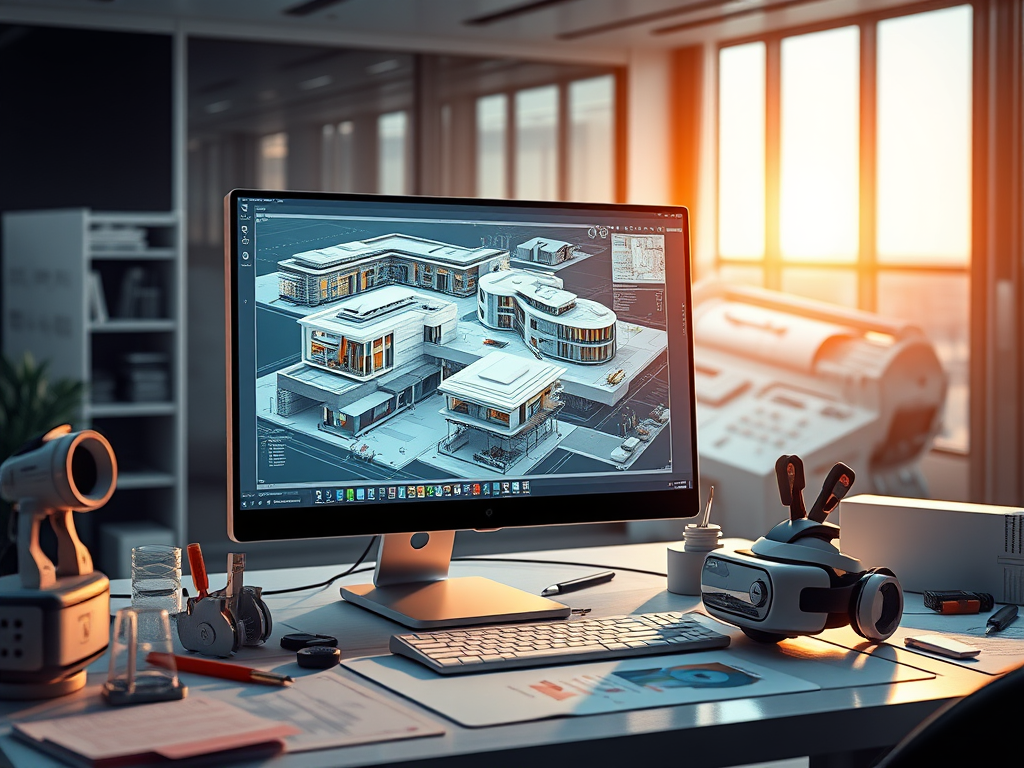
The CAD (Computer-Aided Design) industry serves sectors including manufacturing, architecture, aerospace, electronics, and automotive.
Market Size
According to market research firm Statista, the global CAD software market is projected to grow from USD 12.2 billion by 2025 to USD 22.7 billion by 2035. Among the key markets, the United States, China, Germany, the United Kingdom, and Japan are the world’s largest CAD markets.
Development Trends
With the continuous advancement of artificial intelligence (AI) technology, the CAD industry will increasingly adopt intelligent solutions. For instance, intelligent modeling algorithms can automatically generate 3D models for buildings by analyzing graphic data, enhancing production efficiency and reducing labor costs. For example, Gstarsoft has recently integrated AI rendering function into its BIM software ARCHLine.XP. This has reduced the time required to produce initial conceptual designs from 3 days to 4 hours—a reduction of 87.5%—while cutting outsourcing costs by 40%. Additionally, the number of project proposal versions has increased by 3 to 10 times, and the project bid success rate has risen by 25%.

Simultaneously, the CAD industry will integrate virtual reality (VR) and augmented reality (AR) technologies to deliver more comprehensive design and presentation experiences. In architectural design, for example, users can directly experience their designed spaces via VR technology to evaluate and modify design effects in real time.
Meanwhile, 3D printing is gaining momentum across industries, and CAD software is adapting to meet the needs of this transformative technology. Additive manufacturing requires precise digital models, and modern CAD tools are optimizing workflows to cater to these requirements. GstarCAD’s 3D Modeling function supports solid and mesh modeling and refine designs with extrude, fillet, and mesh editing tools . Its flexible 3D orbit controls (free orbit, axis-aligned rotation) and customizable visual styles enhance model visualization, while built-in solid analysis provides key data like volume and center of gravity .
Application Areas
CAD software has been widely adopted across various industries, including architecture, manufacturing, automotive, electronics, and military engineering. The architecture sector stands out as one of the primary application fields for CAD software.
A report by the Design Management Institute (DMI) indicates that over 80% of architects, interior designers, and civil engineers worldwide currently use CAD software for architectural design. As urbanization accelerates, the demand for CAD software in the architecture industry will continue to rise.
Future Development Directions
The CAD industry will evolve toward three core directions: intelligence, collaboration, and visualization.
Intelligence: Further integration of AI technologies and automated algorithms, such as fully automated modeling and intelligent optimization algorithms, and also customer services. Gstarsoft has recently intergrated an AI customer service, which addresses pain points of traditional customer service such as long waiting times and inconsistent SOP (Standard Operating Procedures) implementation. This AI service is capable of automatically matching the knowledge base, accurately understanding users’ needs, and providing precise solutions.
Collaboration: Enhanced collaborative features in CAD software, including multi-user co-design and cloud-based collaborative editing, to enable more efficient team collaboration. Gstarsoft has launched GstarCAD 365, a cloud based solution that enables cross-platform and multi-user collaboration, allowing users to view, design, and manage drawings from anywhere. It offers an all-in-one solution for design, engineering, and manufacturing, with features like real-time communication and cloud-based document sharing. The software has been widely adopted across various industries such as engineering, construction, decoration, and manufacturing, etc.

Visualization: Deeper integration of VR/AR technologies to provide users with more realistic and intuitive design and presentation experiences.
Advanced Point Cloud Processing: Advanced algorithms now quickly turn point clouds into detailed CAD/BIM models. Rather than manually tracing lines and curves, software automatically identifies and classifies architectural elements, converting raw scan data into accurate digital blueprints. This speeds up workflows, cuts human error, and delivers precise, reliable models. GstarCAD Point Cloud 2026 is a good example. Integrated with Undet Point Cloud plugin, this powerful solution offers a full suite of tools that allow you to seamlessly import and manage point cloud data directly in GstarCAD.
Expert Opinions
John, President of the International CAD Association, emphasizes that the future of the CAD industry will be increasingly dependent on AI technology. He states: “Intelligence will inevitably become the mainstream of the CAD industry’s future development, which requires us to invest more resources and time in researching and applying relevant technologies.”
Han Maogen, Member of the Chinese Academy of Engineering, argues that future CAD software will prioritize user experience and visualization effects. “Customers need more than just a simple design tool—they seek visual solutions that allow them to intuitively view results and interact in real time. For CAD software, this demands more intelligent algorithms and more efficient computing power.”
About Gstarsoft
Gstarsoft Co., Ltd., established in 2001, is a leading provider of R&D-focused industrial software. With a mission to be “customer-centric – making design more efficient, collaboration smoother, and value sustainable,” the company is committed to becoming a world-class, product-innovation-driven industrial software provider, delivering a full spectrum of solutions including 2D CAD, 3D CAD, BIM, and cloud-based CAD.






pretty interesting, i’m looking for a 3D solution that can handle this kind of situations ; do you have any reco ?
Hi Nicolas, can you describe the situation to us? thank you!